
The Opportunity Atlas allows users to interactively explore data on children’s outcomes into adulthood for every Census tract in the United States. This can inform local efforts to build equitable, prosperous, and healthier communities.
In the Boston Edison neighborhood of Detroit, black children raised in low-income households have grown up to have an average household income of $28,000/year as adults, and under 1 percent of that population has been incarcerated as adults. In contiguous Dexter-Linwood, just one census tract to the north, the average earnings for the same group is $17,000/year, with adult incarceration rates hovering close to 8 percent.
If some neighborhoods lift children out of poverty, and others trap them there, the obvious next step is to figure out how these communities differ. Travel to Charlotte, N.C., which has one of the highest job growth rates in America. But data reveals (surprisingly) that availability of jobs and a strong regional economy do not translate to upward mobility in this region. Children who grew up in low-income families in Charlotte have one of the lowest economic mobility rates in the nation. What does help, according to the The Opportunity Atlas (the Atlas), is growing up with less discrimination, around people who have jobs and higher incomes—but only when those factors are found in their immediate neighborhood. If they are present a mile away, it doesn’t seem to matter much according to the data.
Those findings offer a glimpse of the remarkably rich insights gleaned from the Atlas—a vast and granular body of data mapped across the United States—now available online and without charge. It builds on decades of research led by Harvard economist Raj Chetty, with support from the Robert Wood Johnson Foundation. It offers new ways to understand what drives social mobility; where significant gaps persist; and how more effective policies and practices can promote greater equity toward a Culture of Health. Most significantly, this data is openly available for use to inform localized approaches to bridge the opportunity gap.
Social Mobility Is Declining
Using data from the U.S. Census Bureau and the Internal Revenue Service (IRS), the Atlas tracks the outcomes of 20 million Americans from childhood to their mid-30s in all 70,000 census tracts with the ability to analyze findings by race, gender, and income. In the past, we could measure neighborhood wealth and poverty at a given moment, but never before could we see how early childhood experiences can influence income into adulthood.
Sadly, the new findings challenge the bedrock principle that America remains a land of opportunity for all. Two broad trends emerge. First, adjacent neighborhoods with similar household incomes and racial makeup can produce children whose adult lives veer off in very different directions. And second, in a single neighborhood, children growing up in almost identical households (in terms of income and family composition) can diverge dramatically as adults—with race being the only differing characteristic.
As we drill deeper into the Atlas data, another conclusion is inescapable: We can no longer assume that children will lead better lives than their parents, and black residents are particularly at risk for moving down the income ladder. In one Prattville, Ala., tract, for example, black children who grew up in high-income households average $19,000 in annual household earnings as adults, compared to $55,000 for white individuals from the same economic group.
Along with income, with its well-established link to health outcomes—the Atlas includes local data on educational level, housing costs, rates of employment, incarceration, and teenage births. At RWJF, we know there is a direct line from opportunity to equity to health—with access to good schools; affordable housing; safe neighborhoods; and quality health care as some of the key stepping stones. When those resources are unevenly distributed across neighborhoods—and sometimes within the same few blocks, as the Atlas illustrates—health outcomes are certain to be inequitable as well.
Data Is a Starting Point
There is much more to learn from The Opportunity Atlas, especially at the local level, where knowledge can often drive the most direct action. Chetty’s team negotiated at length with the Census Bureau and the IRS to offer open access to this vast storehouse of anonymized data. That was a highly unusual decision for scholars, because data is the coin for academic advancement, and researchers typically hold it close. Their recognition that cooperation, not competition, is the best way to mine information and improve opportunity for children across the United States is truly something to applaud.
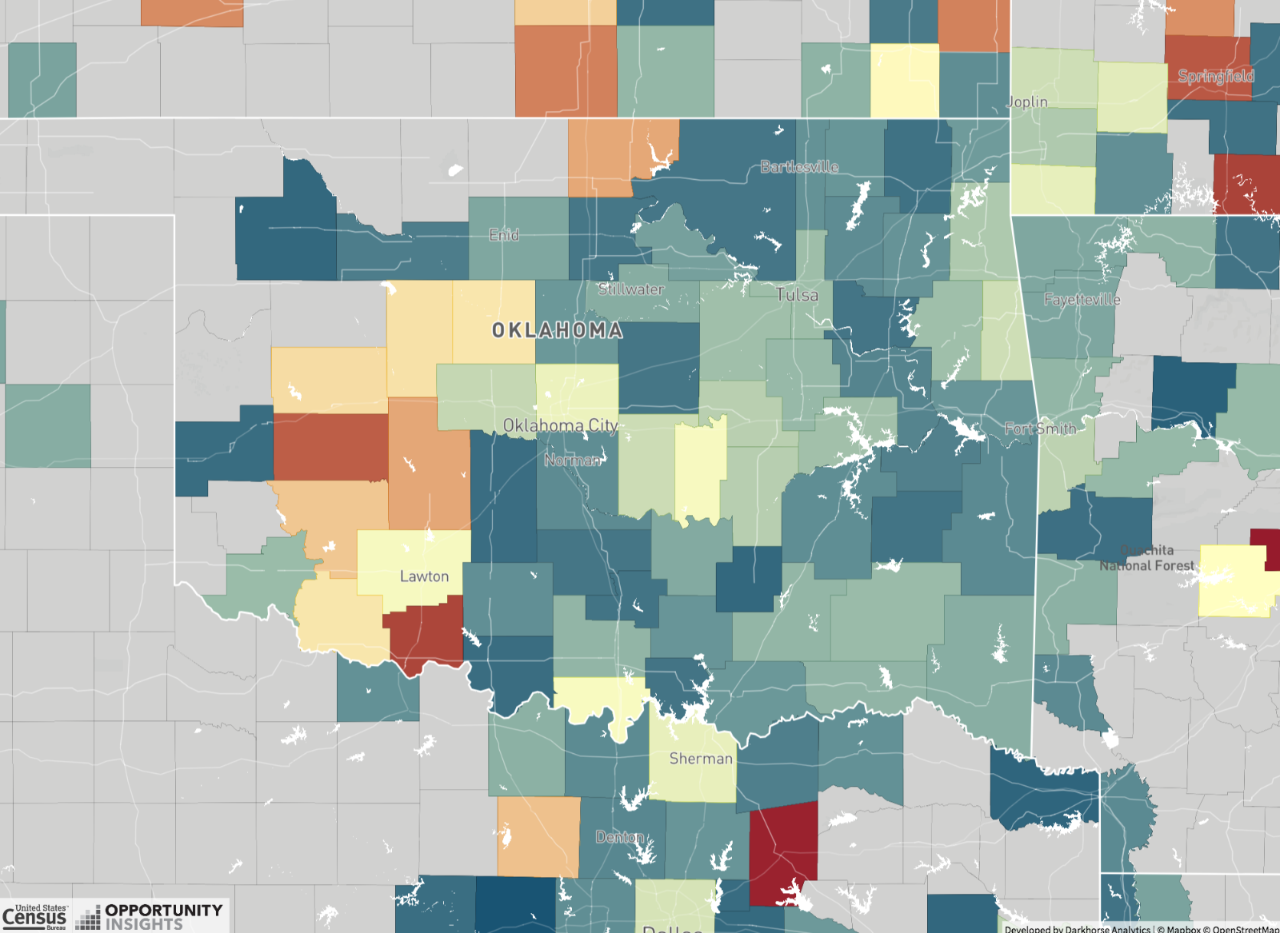
This new tool raises as many questions as it answers. Why do low-income American Indian children in Oklahoma move into the middle class as adults in much greater numbers than the same population growing up in South Dakota? Why do children in rural Eastern Iowa have greater economic mobility than children from similar family backgrounds in urban areas—while in parts of North Carolina, the rural/urban divide is reversed? Why do Compton and Watts, both poor communities in central Los Angeles, offer such different opportunities to children who are raised there? The Atlas is only a starting point to dig deeper into these kinds of questions.
Solutions Are Local
Ultimately, every community will have to figure out how to make the best use of the available information in their own backyards. The right solution often depends on very specific local conditions, resources, and preferences.
What Chetty and his team of economists and data scientists have done is to develop an elegant methodology that maps the roots of childhood opportunity, and to provide a user-friendly design so that descriptive data from every Census tract can be accessed with just a few mouse clicks. A detailed user guide explains how to break out and compare outcomes across regions.
The platform also allows viewers to overlay their own data onto the map. Whether it is the location of liquor stores or parks, rates of asthma or pre-term births, proximity to transportation or hospitals—that feature reveals how any of those health-impacting factors, or a combination of them, correlate with upward mobility.
From there, it is up to policymakers, advocates, scholars, and other community leaders to diagnose the nature of their own challenges, and identify setting-specific solutions. For example, based on the finding that some Seattle neighborhoods offer affordable access to upward mobility, the city developed the Creating Moves to Opportunity initiative, helping low-income families use housing vouchers to relocate to these so-called “opportunity bargains.”
There are countless other ways to use the Atlas. Becky Hatter, the president and CEO of Big Brothers Big Sisters of Eastern Missouri, sees it as a tool to “truly understand the lived experiences” of families. While in Rhode Island, the data is helping a mayor make strategic decisions about where to invest in new initiatives. In Jackson, Miss., Bill Bynum, the Hope Credit Union CEO, uses the information to “more effectively target robust, affordable, and responsible financial services that strengthen communities.”
In each of these communities, very big data is being used to look at very small areas. We think that is the way forward in the drive to create healthier, more equitable, and more prosperous neighborhoods across America.
How might your community apply findings from The Opportunity Atlas? Share your ideas in the comments below.
About the Author
Kerry Anne McGeary is an award-winning professor and researcher, and is a nationally-recognized economist whose extensive research has focused on economic policy, health economics, and health services.